
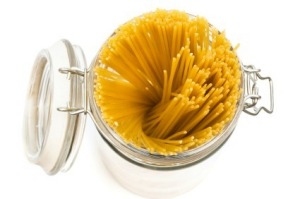
 Has this ever happened to you? You are cooking pasta for dinner, and you just aren’t quite sure how much you need. So you dump what looks like a good amount into the pot, but when it is done, you realize you have too much pasta for the amount of sauce you’ve made.
Or, even worse, you don’t have enough pasta. So you make some more. But then you don’t have enough sauce … the problem could go on forever.
Since we cook hundreds of pounds of pasta each week — all in perfect portion sizes — we thought we’d share some of our favorite tricks for assuring you have the perfect amount of pasta every time.
Read the recipe
This may sound silly, but stop and think about it. How many times to you actually match the amount of pasta you cook with what is called for in the recipe? By reading the recipe and assuring you have the correct amount of the type of pasta called for (or a another pasta of a similar size), you should end up with the perfect sauce to pasta ratio. Be sure to measure the pasta, either with a measuring cup or kitchen scale, for the best results.
Measuring long, skinny pasta
Place a bunch of spaghetti (or fettucini, capellini, etc.) between your thumb and forefinger. One serving should form a bunch about the diameter of a quarter. You can also use a pasta-measuring tool, where you put bunches of pasta through various-sized holes to determine the amount needed, but it isn’t necessary.
Measuring small shaped pasta
A pasta-measuring tool won’t work for smaller pastas like elbow macaroni or small shells. Instead, you’ll need to break out a measuring cup or a food scale. One serving is about 1/2 cup of dried pasta, or about 2 oz (57g) on a kitchen scale.
Measuring large shaped pasta
For larger pastas like bowties, penne or fusilli, a kitchen scale is best. The odd shape makes for a lot of open space between the individual noodles, so weighing out 2 oz servings is going to give you the most accurate measurement. But if you don’t have a scale, never fear. You can just use a measuring cup, but bump the size up to 3/4 cup.
Measuring lasagna and other flat noodles
Recipes will often specify how many noodles are needed for layered pasta dishes, but if they don’t, weight is the best way to go. If you don’t have a scale, you can get a rough estimate by assuming a 2 oz serving is approximately 2 and 1/2 pieces of dry lasagna.
Egg noodles – the exception to the rule
Egg noodles are one of the few pastas that have the same volume dry as when they are cooked. Because of this, you need to be sure to bump up the pre-cooked sized to 1 and 1/4 cup, which should yield about the same amount.
Hopefully these tips will help you achieve the perfect balance of pasta and sauce next time you are cooking. And these tips have an added benefit — knowing the perfect size for each portion will help assure you don’t have a carb overload!