
Weather a and solar energy have long had a tumultuous relationship. Earth’s protective atmosphere shields us from the sun’s harmful effects, but it is also a hindrance when it comes to harvesting solar energy — clouds obscure the sun, snow covers up panels and wind blows dust on them.
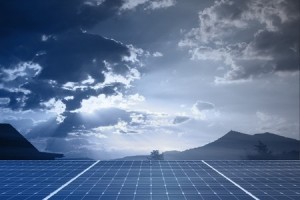 Because of the large amount of sunlight they receive, deserts have long been a prime location for solar panels, but it comes at a cost — when dust and sand particles settle on the panels, this can greatly decrease their efficiency.
Scientists have been hard at work developing ways to keep solar panels free of particulate matter without using impractically large amounts of water. A researcher at the University of Houston has developed a nano-particle coating that repels dust and water. And scientists at Boston University have created a technology for solar panels that enables them to self-clean by vibrating.
In southern Europe, researchers at the University of Nice Sophia Antipolis are using mathematical algorithms to track movements of dust storms in the Sahara that are responsible for spreading clouds of sand particles around for miles. Such technology would allow solar stations to get a heads up on storms headed their way, allowing them to store greater amounts of energy on good days to remain operational on bad ones.
There has also been talk of launching solar panels into space to escape the obscuring effects of clouds in our atmosphere all together. Japan has recently begun making plans for building a solar station in space that could generate power for use on Earth.
Engineers at Brigham Young University in Utah are working on ways to launch solar arrays into space in a compact form using origami folding techniques.
While snow is pretty, it’s not so great when it’s piled high on rooftop solar panels. Utility companies are using net-metering for customers with grid-tied solar to help negate the lost energy savings resulting from cloudy and snowy days by averaging out the amount of electricity produced for the entire year.
Not sure what you need to do to protect your solar panels from the elements? Feel free to ask us how to keep the weather from stealing those awesome energy savings!