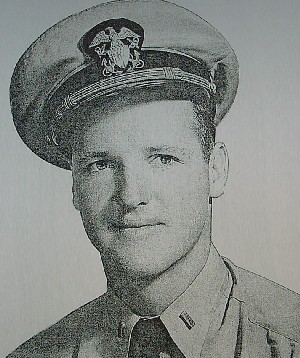
 a “pilot’s pilot, a man’s man, and a loyal and true friend.” Eastmond displayed coolness, courage and skill in the face of enemy aircraft during the crucial Battle of the Philippine Sea in June 1944, which decimated the Japanese Imperial Fleet.
The Provo native enlisted in the Navy’s Aviation Cadet Program on July 11, 1941 and earned his aviator wings on March 12, 1942. After serving as an instructor pilot, Eastmond joined Fighter Squadron One in the Pacific, flying an F6F “Hellcat” off the aircraft carrier U.S.S. Yorktown. From December 1943 through August 1944, the “High Hatters,” as the squadron was known, participated in battles around the Gilbert, Marshall, Mariana and Bonin Islands.
On June 12, 1944, U.S. carriers began a series of air strikes on the Marianas, which caught the Japanese Imperial Fleet by surprise. The Marianas Islands were vital to the security of Japan, which had bases on Saipan, Tinian, and Guam. Control of the Marianas would put the Japanese home islands in range of the new American B-29 Superfortress bombers.
Task Force 58 led the attack to occupy the Marianas with a late afternoon assault that destroyed one-third of the defending Japanese air force, and in the succeeding days the group bombed and strafed shore installations and shipping, which prepared the way for the amphibious assault on Saipan on June 15. Eastmond scored his first combat victory over the Marianas Islands on June 12. Three days later, he shot down his second enemy aircraft over Bonin Island.
The Japanese immediately ordered a counterattack. On the morning of June 19, the Japanese sent 400 planes in four waves to challenge the Americans in the greatest carrier battle of World War II. The result was a disaster for the Japanese. American pilots shot down more than 300 planes on the first day and sunk two enemy carriers while losing only 29 of their own planes. A pilot from the USS Lexington remarked, ‘Why hell, it was like an old-time turkey shoot down home!”
The F6F “Hellcat,” with its powerful engine, protection, and firepower completely overwhelmed the Japanese A6M Zero and Ki-61 planes and their inadequately trained pilots. The Americans lost fewer then two dozen “Hellcats” in air-to-air combat and racked up 480 kills. The Imperial Japanese Navy would never recover.
During the battle, Eastmond led his division on a determined attack to intercept a superior number of enemy aircraft and distinguished himself by shooting down four enemy aircraft attempting to strike the Yorktown in a matter of minutes. Eastmond continued to fly combat missions and was credited with a total of nine enemy kills, one probable kill, and the sinking of two enemy destroyer escort vehicles, which qualified him as a Navy “Ace.” He was awarded the Navy Cross, the Distinguished Flying Cross, and several air medals.
After World War II, Eastmond remained in the Naval Reserve until retiring in 1966. He later flew as a corporate pilot for Wheeler Machinery Co. and worked as an assistant administrator at Primary Children’s Medical Center and LDS Hospital. Eastmond died of a heart attack on Nov. 4, 1981 in Salt Lake City. He was inducted into the Utah Aviation Hall of Fame on May 26, 2001.