
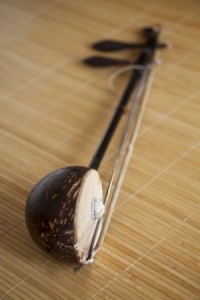
 What we know as the traditional stringed instruments — violins, violas, cellos, basses — are only a small part of a larger culture of many other stringed instruments that are traditional around the world.
Some are rudimentary instruments with tribal significance, and some are highly developed, complex instruments that simply aren’t well-known in the United States.
Here are three unique instruments that will wet your whistle with curiosity about what other musical delights are hiding out in the world!
1. Brazil’s berimbau
The Berimbau is a Brazilian bow instrument that’s closely tied with Capoeia, a Brazilian marshal art. The instrument is fairly rudimentary, using a bowed stick and wire for the base (it looks like a bow and arrow) that uses a gourd for acoustics, a rock for tone changes, and a small stick to play the wire. Listen and learn more about this instrument here.
2. The hurdy-gurdy
The hurdy-gurdy has strings, but it’s played with a crank and keys. The crank controls a rosined wheel, which in turn rubs against the strings, and a keyboard is used to change the pitch of one or more strings.
Playing one string results in a violin-like sound. However, most hurdy-gurdy’s have “drone strings” that give a monotone pitch accompaniment to a played melody, not unlike the bagpipes.
The hurdy-gurdy’s origins go all the way back to the ninth century. Today you can find it chiefly used in French, Hungarian and Gaelic contemporary folk music. Listen and learn more about this instrument here.
3. China’s erhu
You may not know the name “erhu,” but I can almost guarantee that you’ve heard one played in a movie or on TV. The unique sound of the instrument makes it easy for a soundtrack to evoke “China” with one note.
The erhu is a two-stringed, bowed instrument that is used as a solo instrument as well as in ensembles. It has a long neck that connects to a “sound box” base that is covered in python skin and is played with a rosined bow. Experts believe that the Erhu has been around for over 1,000 years, originating in central Asia and turning up in China in the tenth century. Listen and learn here.