Let’s face it. It’s hard to imagine a life without chocolate. What would enhance our cookies? What would we wrap our nougat in? What would we put on our banana splits and in our s’mores? Let’s not dwell too much on it, it’s just too difficult.
Luckily for us, and for a lot of people in the last 2,000 years, we haven’t had to face a reality without chocolate. In fact, chocolate has been revered for so many years there’s even evidence of it in Mayan art and hieroglyphics.
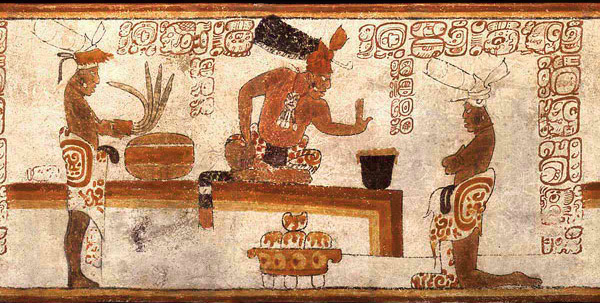
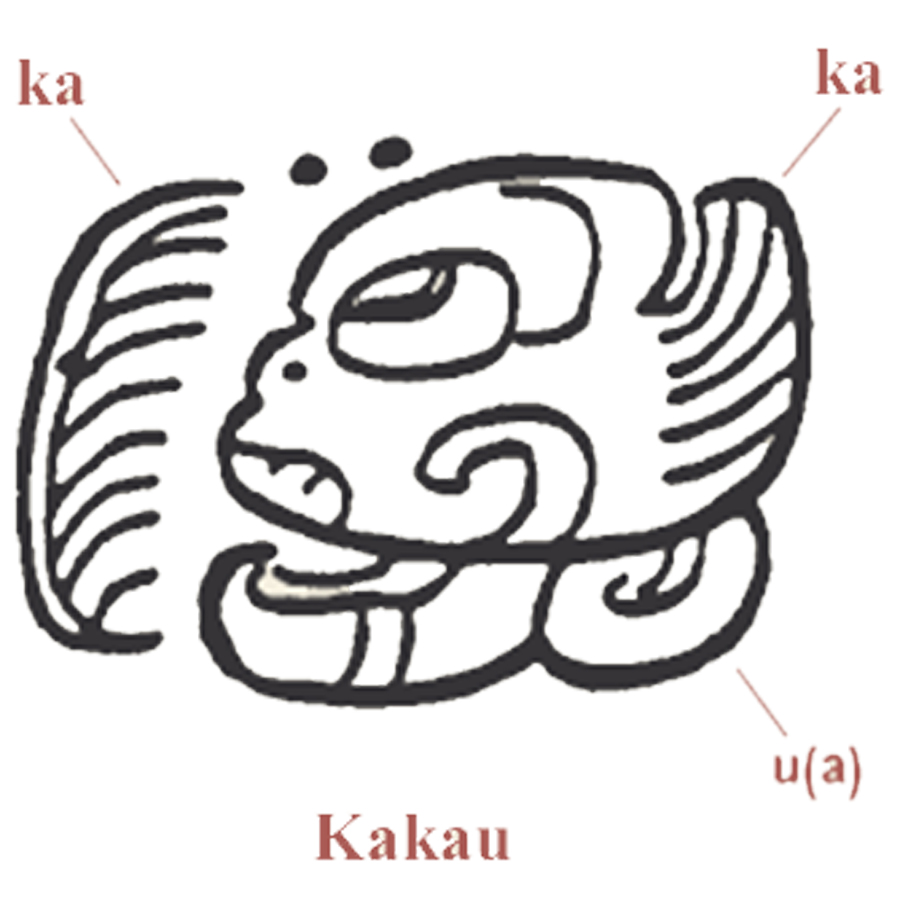
In this art, dating from A.D. 600–800 you can see a Mayan lord being presented with a bowl of frothing cacao, or chocolate. You may wonder, how do we know it’s chocolate? See that little glyph, second from the bottom on the far right column? It’s the sign for cacao.
In the ancient Americas, chocolate was for the privileged and royalty. In fact, when the Spaniards first arrived at the Aztec capital of Tenochtitlan in 1519, among the lavish spectacles they witnessed was King Moctezuma being served more than 50 jars of foaming chocolate. A man after our own hearts.
In the time of the Aztecs, cacao was central to their political power and played a role in rituals of all sorts, including funerals and marriage celebrations. There were even times that it was used like currency with values putting a turkey around 200 cacao seeds, a tamale worth one, and the daily wage of an average man at 100 cacao seeds. Would you consider being paid in chocolate?
Interestingly enough, some chocolate-loving historians believe that chocolate has been around much longer than the 2,000 years which has been widely believed. There is even detective work being done on ancient dirty clay pots by chemists at the labs of the Hershey Company. These researchers are looking at pushing back the antiquity of cacao beverages by another 2,000 years, which would take us back to at least 1500 B.C.! These calculations would make chocolate over 3,500 years old!
Understanding the early history of chocolate has led archaeologists to speculate that cacao played critical roles in the economic, religious, and political development of people such as the Olmec, Maya, and ultimately even the Anasazi, or Ancestral Puebloan peoples of the American Southwest.
When we say we can’t imagine a life without it, we mean it. With chocolate an important part of many civilizations throughout the history of our world, we’re glad we don’t have to live a day without it. Denying ourselves chocolate is like denying our heritage. Indulge!