
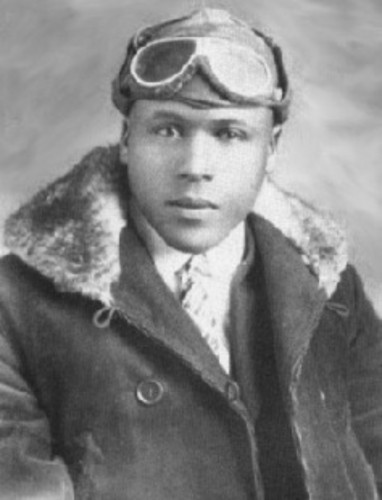
 James Banning dreamed of one day becoming a pilot. But learning how to fly in a day and age of racial segregation when many people believed Blacks shouldn’t have the opportunity to fly, wasn’t going to be easy.
When his family moved to Ames, Iowa in 1919, Banning entered Iowa State College where he studied electrical engineer. While in college, Banning became “air minded” but dropped out after a little more than a year to focus on his auto repair business.
Banning never gave up his dream though to become a pilot. In 1920, Banning attended an air circus and paid $5 to take a 45 minute plane ride. He was repeatedly turned away from flying schools because of his race, but in 1924 Banning met World War I flying ace Raymond Fisher who agreed to give him private flying lessons at his school in Des Moines. Banning told a Pittsburgh newspaper in 1932 that, “I would shake and shiver through a half hour dual instruction … I need not mention the added shiverability provided by the shaking, trembling old plane in which we trained.”
In 1926, Banning became the first African-American in the United States to receive his pilot license. He saved enough money to buy his own biplane which he named “Miss Ames” in honor of Ames, Iowa, and barnstormed all over the country. He left Ames in 1929 and moved to Los Angeles where he became the chief pilot for the Bessie Coleman Aero Club, a flying school for Blacks.
Banning, accompanied by mechanic Thomas Allen, became the first black aviator to fly coast-to-coast from LA to Long Island in 1932. They made the 3,300 mile trip in 41 hours and 27 minutes. The trip took 21 days to complete because they did not have a sponsor and were forced to raise money along the way at each stop. The trip was widely covered by the media and they became known as the “Flying Hoboes.” They were met by enthusiastic crowds as word spread of their trip. At one stop in St. Louis, students from a nearby flying school took apart the plane’s ailing engine and brought new engine valves to help get them on their way. In Pittsburgh, Banning met Robert Varn, who was campaigning for FDR. Varn gave Banning thousands of flyers to drop from his plane. In return Varn paid for their trip home.
Four months after his historic flight, Banning was tragically killed in a plane crash at an air show at Camp Kearney in San Diego on February 5, 1933. Banning had planned to perform a number of stunts as part of an air circus show to raise funds to return east, but the show’s promoter refused to let him use a plane because he did not believe Banning was a capable pilot. Instead, Banning got into the backseat of a two-seater Travelair biplane flown by Navy machinist mate Albert Burghardt as a passenger. Hoping to impress his famous passenger, the pilot pulled into a steep climb after takeoff but the plane stalled in midair and crashed to the ground in front of a crowd of more than 2,000 horrified onlookers. Banning was gently lifted from the wreckage and rushed to a nearby hospital where he died a short time later having never regained consciousness.
Banning was only 33 years old when he died, but left behind a legacy as a trail-blazer who overcame racial prejudice and an unequal struggle with poor equipment, to advance the cause of Black aviation.