
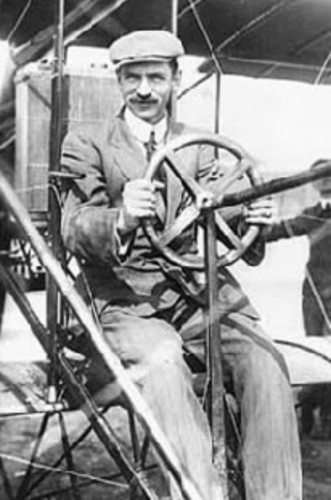
 Glenn Curtiss may be better known today as the “Father of American Naval Aviation.” But before he was designing planes for the Navy, Curtiss was actually known as the “Fastest Man on Earth.”
Like those other famous aviation pioneers, Orville and Wilbur Wright, Curtiss first developed an interest in bicycles. He started out as a Western Union delivery boy, and later opened his own business designing, building, and repairing bicycles. As his bike riding abilities grew, Curtiss started racing them and became a champion racer. Fascinated with the internal combustion engine, Curtiss later added an engine to his bicycle which led to an interest in motorcycles. He said of his first attempt to build a motorcycle that “it almost tore itself loose from the frame.”
In 1902, Curtiss formed a new company, G.H. Curtiss Manufacturing Company, and began producing motorcycles. His lightweight, air cooled engines were some of the best available in the United States. Driven by a need for speed, he became the first American motorcycle champion in 1903, setting a land speed record of 64 miles per hour for one mile, and in 1907 set the record of 136 miles per hour on one of his own V-8 powered motorcycles – a record that stood until 1930.
His success with engines soon attracted the attention of early aviators. In 1904, Curtiss supplied the engine for the California Arrow, the first successful dirigible flight in America, and in 1908 joined the Aerial Experiment Association, a pioneering research group founded by inventor Alexander Graham Bell to build flying machines.
Curtiss would go on to make the first officially witnessed flight in America, won a race at the world’s first international air meet in France, and made the first long distance flight in the United States. His contributions in designing and building aircraft led to the formation of Curtiss Aeroplane and Motor Corporation.
In the years leading up to World War I, his company built aircraft for the U.S. Army and Navy, and his experiments proved that guns could be fired from an airplane and that an airplane could successfully be launched and land from warships. Curtiss also developed the first hydroplane.
In 1914, Curtiss developed the Model J which was the forerunner to the famous JN-4 or “Jenny.” Over the next few years, Curtiss manufactured more civil and military aircraft than any other American during World War I and up to the World War II era.