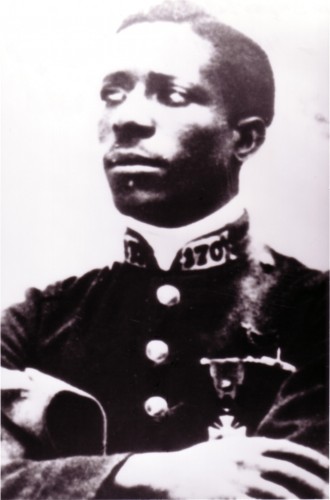
 The world’s first black combat aviator was born in America but earned his fame flying for France in World War I because his own country denied him the opportunity to fly because of his race.
Eugene Bullard was born in 1894 in Columbus, Georgia, the seventh of ten children born to William and Josephine Bullard. Bullard grew up in the segregated South but lived by his father’s belief that a man should be judged on merit and not the color of his skin.
Bullard left home when he was eight years old after witnessing the near lynching of his father, and joined a group of traveling gypsies where he learned to race horses. Seeking to escape racial discrimination, Bullard, now a teenager, stowed away on a ship bound for Scotland. Bullard had dreamed of reaching France one day because his father told him that in France a man is accepted regardless of his skin color. Over the next ten years, he found work in various jobs including as a lookout for gamblers, part of a traveling vaudeville act, and a prize fighter, where he won bouts in England and France. Bullard appeared in Paris for the first time at a boxing match in November 1913 and decided to settle there.
When World War I broke out in 1914, Bullard joined the French Foreign Legion and fought as an infantryman in some of the biggest battles from 1914 to 1916. After he was seriously wounded at the Battle of Verdun and declared unfit for duty, Bullard joined the French Air Force. On May 7, 1917, Bullard became the world’s first black fighter pilot. He flew over twenty combat missions where he became known as the “Black Swallow of Death.”
When the United States entered the war, Bullard tried to join the American Air Force. Although he passed the physical and had earned medals for his valor, his application was ignored. In 1919, Bullard was discharged from the French Army and remained in Paris where he owned a nightclub. The club was frequented by celebrities such as Louis Armstrong, Ernest Hemingway, Gloria Swanson and Josephine Baker.
When World War II broke out, Bullard agreed to spy on Germans in his nightclub since he spoke the language. When Paris was overrun, Bullard joined in the fighting and was wounded. He was smuggled out of the country and lived the rest of his life in relative obscurity.
France, however, never forgot him. In 1954, Bullard was invited by the French government to relight the flame at the Eternal Flame of the Tomb of the French Unknown Soldier under the Arc de Triomphe. And in 1959, he was made a Knight of the Legion of Honor. Bullard died in October 1961 and was given full military honors by the Federation of French War Officers. America did not acknowledge Bullard’s place in history until 1994 when he was posthumously commissioned a lieutenant by the USAF.