
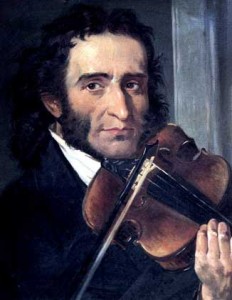
 Niccolo Paganini’s radiant career established the musician as one of the most enthralling figures in the history of music. Born on October 27, 1782 in Genoa, Niccolo played the mandolin at the age of five, and the rudiments of the violin at age seven. The young artist thirsted for musical betterment, and his parents sacrificed to pay for lessons. Niccolo never entirely conformed to his teachers’ straight-laced approaches to the violin. Instead, he much preferred to experiment, using ticklish left-hand plucking and springing-bow movements.
The child prodigy sought tutelage under Antonio Rolla in Parma who, after hearing Niccolo play, exclaimed, “I can teach you nothing. Go to Paer!” And, so he did. Paganini gleaned knowledge from various well-regarded teachers of the instrument, but always refused to stylistically submit to the classical masters. He craved something different, and developed his own unique style of composition and performance.
Niccolo dominated a competition at the festival of Lucca, where he remained as a freelance musician, until Princess Elise, who had set up court there, recruited him. In 1809, Paganini left Princess Elise’s court at Lucca to pursue life as an itinerant soloist.
The talented musician regaled audiences by interspersing his performance pieces with imitations of donkeys, roosters, and other animals, which he teased from the violin. Though comedic when he chose to be, his soaring talent bewitched rambunctious Italian theatre patrons, transforming them into quiet, attentive admirers.
He let his hair grow long, cultivating an air of mystery. The violinist preferred solitude, while on tour, and he developed the habit of fasting, at times remaining at rest in a darkened room the day before a concert. He described experiencing a feeling of “electricity” when he performed, and his audiences characterized him as someone possessing supernatural power. Dark rumors began to spread that this talented young virtuoso had made a Faustian bargain with the devil to gain his prowess at the violin.
It was in 1813, in the city of Milan, that Paganini’s reputation spread like wildfire. He formed the habit of taking popular themes from operas, ballets, or national folk tunes and adding variations that showed off his violin playing. The wandering virtuoso achieved fame across Europe. Then, in 1824, Matthaus Nikolas de Ghetalde heard a report that Paganini played each evening in the cemetery on the Lido. People gathered to hear him play gratis in respect for the deceased. Picture this: hair flowing spectrally, long fingers flying feverishly over the strings, fiery eyes lost in the darkness. It’s no wonder word of his fame spread so quickly.
In England, The Times gave this account: “He is not only the finest player perhaps that has ever existed on that instrument, but he forms a class by himself, and produces effects which he has been the first to discover, and in which few, if any imitators will be able to follow him.” This great musician died at age fifty-seven following a reoccurrence of longstanding health woes — a loss deeply mourned by many.