
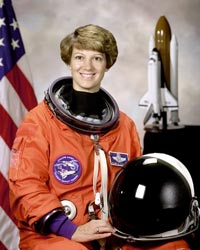
 Eileen Collins was in fourth grade when she came came across an article in Junior Scholastic about the Gemini program and whether the country should invest in space or not. She remembered thinking, “Why would anybody say no? Of course we need to go out in space.” Collins would grow up to realize her dream of one day becoming a pilot, joining the Air Force pilot training program and would later be selected by NASA in 1990 to join the astronaut corps. She would become the first woman to pilot and command a U.S. spacecraft.
As a young girl, Collins read books about the Wright Brothers’ gliders and all of the planes from World War I and II, and Vietnam, and fantasized about flight. Gazing up at the stars one summer at camp in Elmira, NY, Collins determined that she would make her dream to fly become a reality. Because her family never had the money to pay for flying lessons or even ride in an airplane, at age 16, she began working and saving her money. Three years later she had saved up $1,000 and took it to the local airport and asked them to teach her how to fly.
Collins dismissed the idea that flying was a “guy thing” and entered the Air Force military training program in 1978. She was inspired by the first class of women pilots who joined NASA’s Mission Specialist Astronauts and decided that her love of history, astronomy, and geology, coupled with her love of flight, made her a good fit for the space program. She earned a bachelor’s degree in math and economics from Syracuse University in 1978, and received two master degrees from Stanford University and Webster University. She completed her U.S. Air Force Undergraduate Pilot Training at Vance Air Force Base in Oklahoma in 1979 and was serving as a math and flight instructor at Edwards Air Force Base when she was selected to join the astronaut corps in 1990.
Collins became NASA’s first female shuttle pilot in 1995 aboard Discovery and became the to the Russian space station Mir. She also piloted Atlantis to the Mir station in 1997, and became NASA’s first female shuttle commander in 1999 when she led Columbia’s mission that launched the Chandra X-ray Observatory.
She returned to flight as commander of Discovery in 2005 leading six fellow crewmates on NASA’s first shuttle flight since the 2003 loss of the Columbia shuttle. The mission tested a series of shuttle safety improvements and fuel tank modifications, and also restocked the International Space Station with supplies.
Collins retired from the Air Force in 2005 with the rank of colonel, having logged more than 6,280 hours in 30 different aircraft and more than 872 hours in space.