
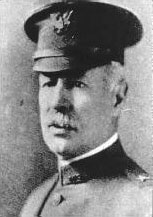
 Major General Mason Patrick had never even been in an airplane when General John J. Pershing asked him to take over command of the Air Service of the American Expeditionary Force in 1918 during World War I. But his no-nonsense executive approach and understanding of the needs of the service brought order during a time of disorganization , political infighting, and budget constraints and ultimately led to the expansion and modernization of the Air Corps.
Patrick was born during the Civil War, the son of a Confederate surgeon. He graduated second in his class at West Point in 1886, where he made friends with Pershing, and joined the Army Corps of Engineers. In 1916, Patrick led the First Regiment of Engineers in the expedition against Pancho Villa in Mexico, and when the U.S. entered WWI, he was sent to Europe to oversee the construction of ports, railroads, depots and airfields needed to support American troops.
In 1918, his old classmate Pershing personally asked Patrick to assume command of the Air Service to “whip it into shape.” The situation at Air Services HQ was described as a “tangled mess” due to personality clashes and internal friction. Patrick used his leadership and organizational skills to provide structure and focus, and by the end of the war the Air Services became an efficient and well run unit and provided the support Pershing required on the battlefield.
At the end of the war, Patrick returned to his engineering duties, but in 1921 he was once again asked to straighten out the country’s air force which was suffering from severe budget cuts and was also embroiled in controversy after Assistant Chief of the Air Service General Billy Mitchell called for them to become a separate branch of the military.
Patrick was one of the first officers to recognize the potential of air power and from 1921 to 1927 he lobbied Congress to increase the size of the Air Service, including adding more trained pilots and new aircraft, and put in the policies that eventually resulted in the creation of the U.S. Army Air Corps in 1926.
Also, at age 59, Patrick earned his pilot’s wings in order to gain the respect of his men and flew whenever possible to demonstrate his confidence in the Air Services equipment. He retired in 1927, having guided American military aviation through its most controversial years and is one of the great yet unsung pioneers of American air power.