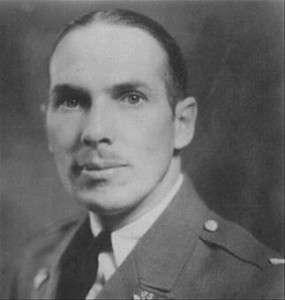
 In a career spanning 18 years, Major Ployer Peter Hill, an accomplished test pilot, piloted and evaluated the capabilities of nearly 60 aircraft for the U.S. military. On Oct. 30, 1935, Hill was called upon to test a prototype of what would eventually become the B-17 bomber or “Fortress.” The craft proved instrumental in bringing the Axis to its knees in WWII. Here is a look at Hill’s career and how that famous aircraft came into being.
Hill was born in Newburyport, Massachusetts in 1894. After graduating from Brown University in 1916 with a degree in Civil Engineering, Hill later enlisted in the Aviation Section of the U.S. Army Signal Enlisted Reserve Corps. He was trained as an aviator at the School of Military Aeronautics at Cornell University, Camp Dix. and at Chanute Field in Rantoul, Illinois. Hill then accepted a commission as a 2nd lieutenant in the regular Army, serving as a flying instructor and later becoming a bomber pilot.
During his career, Hill served in the Office of the Chief of the Air Corps in Washington, D.C., saw duty with the American Army of Occupation in Germany as the Engineer Officer of the Air Service Flying Station in Weisenthurm and was assigned to the 12th Aero Squadron at Fort Bliss, Texas. Later, he served at Chanute Field as an instructor in aerial photography
In 1924, Hill returned to duty in Washington, D.C. in the Training and War Plans Division. In 1925, he was ordered to Mitchel Field in New York where he became commanding officer of the 14th Photo Section. He held that job until 1929. His next assignment took him overseas to Manila, where he served as CO of the 6th Photo Section at Nichols Field.
Hill returned stateside in 1932 and was assigned to Wright Field in Dayton, Ohio as a test pilot and Assistant Chief of Planes and Engines. He was promoted to Major in 1935 as Chief of the Flying Branch of the Material Division at Wright Field where he tested and evaluated such experimental aircraft as the Consolidated P-30, B-10, B-12, and many others.
In 1934 the Army Air Corps was looking for a replacement for the B-10. They wanted a new plane that was capable of carrying a “useful bombload” at an altitude of 10,000 feet. The Army also requested the planes be able to stay in the air for ten hours with a speed of 200 mph and a range of 2,000 miles.
Douglas, Martin, and Boeing brought their protoypes to a 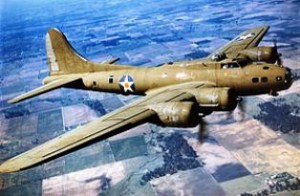 Boeing’s prototype could hold 4,800 pounds of bombs and was powered by four Pratt & Whitney engines. Upon seeing the plane, Richard Williams, a reporter for the Seattle Times, exclaimed: ”Why, it’s a flying fortress!” Boeing officials loved the name and subsequently the name was trademarked.
The plane flew from Seattle to Wright Field in nine hours and three minutes at an average speed of 235 mph, which surpassed its competitors and impressed Army brass, who placed an order for 65 planes.
On October 30, 1935, Major Hill and Les Tower took the experimental Model 299 up at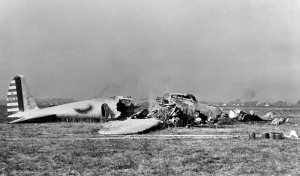 Wright Field, but forgot to disengage the “gust lock,” which was intended to keep the control surfaces from moving when the plane was on the ground. The plane stalled as they climbed, and crashed. Both men were killed.
Despite the accident, the Air Force was impressed with the plane. Boeing modified the aircraft in the coming years and by the end of WWII, 12,731 B-17 planes were made. Members of the 8th Army Air Force called it “the mightiest ever built.”
Hill was buried in Newport, Massachusetts on November 3, 1935. In 1939, the War Department renamed the site of the Ogden Air Depot to Hill Field in honor of Maj. Hill.