
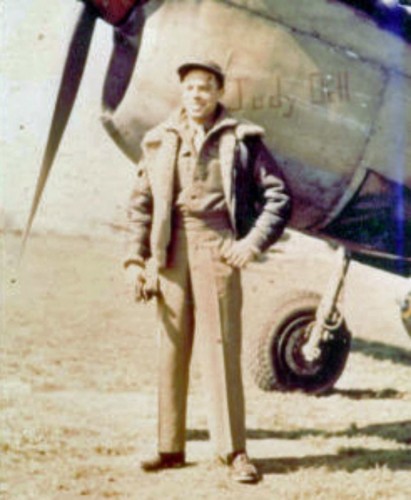
 In 1941, the United States did not want the Tuskegee Airmen to fly for them. In 1945, Germany felt the same way. The group of African- American fighter pilots which went on to serve with legendary distinction during World War II had to fight two wars: one for democracy in Europe and one against discrimination right here at home. William Thompson joined five other men as the first aviation cadets of the African-American 99th Pursuit Squadron that later became known as the Tuskegee Airmen, and had to overcome the barriers of race to be taken seriously by his white colleagues.
Thompson was born in Pittsburgh in 1916 and developed a love of flying from an early age. He earned his civilian pilots license while also earning his bachelors degree in business administration from Hampton University. Following graduation, Thompson attended the Coffey School of Aeronautics and worked as a civilian pilot before the outbreak of World War II. Following the attack on Pearl Harbor, Thompson enlisted in the Army Air Corps.
Before 1940, African Americans were barred from flying for the U.S. military. Pressured by civil rights organizations, the federal government formed an African American Pursuit Squadron based in Tuskegee, Alabama in 1941. Collectively called the Tuskegee Airmen, the 99th was made up of pilots, mechanics, sheet metal workers, armorers, weather observers, parachute riggers and support staff needed to keep the planes in the air.
Thompson was first brought to Scott Field in Illinois but was later transferred to Chanute Air Force Base to complete his training. Unfortunately, Thompson enlisted too soon to become a pilot because there were no airplanes to train on at the field at that time. Instead, he became part of the armament section that was responsible for making sure the planes were armed and prepared for flight. Even then, conditions for African American trainees were different than their white counterparts. As Thompson recalled, the black cadets were housed in an old ten story WWI barracks across the railroad tracks that separated them from the white cadets. White cadets wore new West Point uniforms while the black cadets were provided with coveralls and fatigues. At the graduation ceremony, Thompson showed up in his coveralls and fatigues and was asked “What are you doing here?” by one of his white counterparts. Thompson answered,”I’m here to graduate. Just like you.” He was grudgingly issued a used uniform to match those of the white graduates and proudly took his place in line with the rest of the white graduates.
After graduating, Thompson was transferred to Tuskegee Air Field. Although black pilots made up the 99th Pursuit Squadron,they struggled to be taken seriously. In fact, they were not even allowed to use the term “fighter squadron.” The pilots trained on AT-6s before eventually receiving used Curtiss P-40 Warhawks. Despite continuing discrimination, Thompson and his fellow Tuskegee Airmen soon proved that they could work together to defeat the enemy. The Tuskegee Airmen flew 1,578 missions and 15,553 combat sorties and downed 112 enemy aircraft. The Tuskegee Airmen did not lose a single bomber to enemy fire in more than 260 combat missions, a feat unmatched by any other fighter group.
Thompson also served as the unofficial photographer of the 99th Squadron, taking pictures on his 35 mm still camera and 16 mm moving pictures camera. Parts of his collection are in the National Air and Space Museum in Washington, DC.