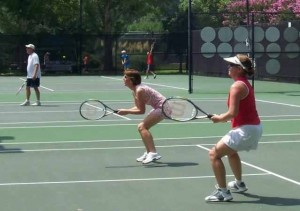
 Round robin offers the perfect format for building a smaller sports tournament. It allows each athlete to play all other competitors in the tournament field and truly determine who is the best.
The standard tournament format operates on a survive and advance principle. Round robin play ensures that each player faces every other player in the tournament. Using the round-robin format does not need to be limited to something like basketball or soccer. You can adapt it to fit a variety of sports tournaments, including tennis.
Scoring
Round-robin tennis features quick games and multiple rotations. It is important to use a scoring system that makes quick matches possible. Standard tennis matches usually last too long to make round-robin play practical or feasible.
Ten-point tiebreakers are a good alternative to the traditional match play. This speeds up play from the usual game, set, match format so that players can rotate from one opponent to the next much more quickly. This scoring format is good to use if the tournament can only be held over a single weekend or on a holiday.
Bracketing
 Seeding in round robin play does not operate on the same principle as other tournament formats. The top seed in a round-robin group isn’t necessarily the best seed. Seeding serves as an organizational tool to facilitate match play.
Assign each player a seed and pair up matches according to seed. For example, in a four-player tournament, No. 1 plays No. 4, then No. 3, then No. 2. The other three players would rotate in similar fashion until all matches are played. If you have multiple tennis courts available at the tournament venue, you can have players rotate from one court to the next for their various matches.
Tips
If you choose a round-robin format and have a limited number of tennis courts available, structure play so that every player receives an equal amount of rest between matches. It is unfair to force players to play all their matches in a row, while others get breaks.
You can include a higher number of participants and simply set up separate round-robin groups based on age, gender or skill level. If you have a large number of participants, consider charging a small entry fee so you can furnish food and drinks for the players.
 Playdriven offers tons more resources on how to organize and stage a tennis tournament in your local community. Check out our website for the latest ideas and tips on what you can do to make your tournament run smoothly.