 Bearing possibly the most recognizable name in science, Albert Einstein was also a passionate admirer of both Mozart and Bach. Pauline, Einstein’s mother, was an accomplished pianist who wished for her son to cultivate a relationship with music.
At 6 years old, Einstein began taking violin lessons. Like many children, the young genius hated practicing music. It was not until the age of 13, when Einstein was exposed to the music of Mozart, that he discovered the joy of music. He threw himself into his violin playing with renewed fervor. Einstein’s second wife later remarked that it was his beautiful renderings of Mozart that first drew her to him. (Take note, science gurus: taking up an instrument can help attract the ladies).
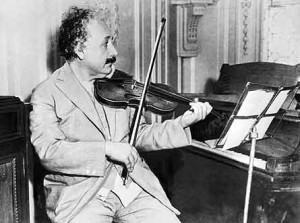
For almost seven decades, the violin was Einstein’s companion. He was known for playing at local recitals, and spontaneously improvising to accompany carolers who came to his door.
Most musicians execute the physics of music without fully understanding it. Physics deals with matter, energy, motion, and force. Waves — such as sound waves — transfer energy without transferring matter. Our ears are awesome receptors for these waves, which are compressional waves caused by vibrations. The musician puts the necessary energy into the instrument to produce the desired sound wave. Standing waves are create either by rubbing/striking strings (chordophones), blowing into constricted columns of air (aerophones) or striking the physical structure of the instrument (idiophones).
Einstein once said, “Life without playing music is inconceivable for me. I live my daydreams in music. I see my life in terms of music. I get most joy in life out of music.” Indeed, Einstein was known to take refuge in music. When trying to iron out a theoretical concern, he would take out his violin and play until inspiration struck.
While at Princeton, Einstein kept his Wednesday nights free for performing chamber music at his house on Mercer Street. In fact, from 1952 until his death three years later, Einstein served as vice president of the Princeton Symphony.