 When our cave-dwelling ancestors scribbled on walls and lit their first fires, they were assuredly dabbling in the styling of sound. They discovered that certain objects made particular sounds when manipulated in a certain manner, and eventually our ancient ancestors began constructing musical instruments.
Percussion came first, then the wind instruments, followed by the stringed, and finally the keyboard. The ancestor of all stringed instruments was, more likely than not, the hunting bow. Which ancient hunter was the first to stretch the strings across a board, thereby increasing the tone and volume? We will never know. Yet, the addition of a hollow soundboard, was a crucial part of developing the primitive characteristics of the violin family.
Some claim the violin developed out of the lyre and cwrth, through the Troubadour fiddle (with the monochord and hurdy gurdy taken into consideration). Others believe the violin to be descended from the Ravanastron, through the rebab, rubebe, rebec, and viol. Judging by the distinctive soundchest of the violin, as well as the etymological trail of stringed instrument names, it could be surmised that it grew from the Egyptian kithara. It’s actually impossible to say whether the violin family “evolved” out of a particular instrumental “lineage” or whether the viols were, as is my opinion, the result of a mental amalgam of the specific characteristics of several bowed chordophones.
Viol, read as the translation of the Italian viola, has been used to classify many antiquated instruments including the viola da gamba (leg-viol), the viola da braccio (arm-viol), the viola d’amore (love-viol), the viola da bardone (baryton), the viola bastarda (lyra-viol), and the viola da spalla (shoulder-viol).
The viola da braccio is the family of viols that we know today as the violin family. Its members are well known: the violin, the viola, the violincello, and, occasionally, the contrabass. Some do not consider the contrabass to be a part of the violin family, but rather a vulgarized version of the violone (a member of the viola da gamba family).
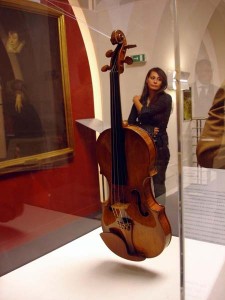
Andrea Amati founded the famous Cremona school of violin making. It was he and his sons, Antonio and Girolamo, who set the style from which subsequent makers took inspiration. Samples of Andrea’s work are still scattered about, the most impressive examples being those made for King Charles IX of France. It’s said that these gilded beauties produced a tone, which is rarely if ever surpassed. Nicolo Amati was Girolamo’s son, and the most famous Amati of all. He was the master from whom Stradivari and Guarneri, both masterful luthiers, learned their craft. The Amatis introduced the amber-hued varnish now seen as typical. The Amatis pioneered the flat, shallow modeled violin which, made better still by Stradivari, is that which we see in modern concert settings.