
 Anchors, away!
It’s been quite a spring for one of golf’s most controversial subjects: anchoring.
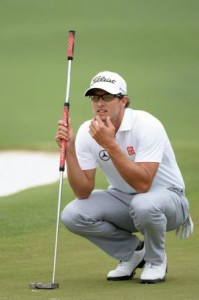
Not only did Adam Scott use the method to help secure his Masters victory in April, but the controversial anchoring technique for putting then got banned by the United States Golf Association and The R&A.
Golf’s governing bodies released a lengthy explanation about the reasoning for the ban, which is set to into effect when the calendar strikes 2016. It even pointed out how the PGA and several other influential golf tours across the world advocated that the proposal against anchoring not be implemented.
Here’s one key segment:
In adopting Rule 14-1b, the USGA and The R&A have concluded that freely swinging the entire club is integral to maintaining the traditions of the game and preserving golf as an enjoyable game of skill and challenge. The essence of the traditional method of golf stroke involves the player swinging the club with both the club and the gripping hands being held away from the body. The player’s challenge is to direct and control the movement of the entire club in making the stroke.
This traditional form of golf stroke has prevailed throughout the centuries since the game began. It is true to say that one can find isolated or episodic examples of anchored methods of stroke dating back into the early 1900s, just as one can find early examples of almost any method of stroke that creative players might invent or try, such as putting in a croquet style (seen as early as the 1900s or before). But it is only recently that a non-trivial and recurring use of anchoring methods emerged, first with the long putter in the 1980s and then with the belly putter at the turn of the 21st century – an extremely short time in the history of this 600-year old game and not reflective of any established tradition.
The concept of intentionally immobilizing one end of the golf club against the body, in a manner equivalent to creating a physical attachment point to use as a fixed fulcrum or pivot point around which the club can be swung, is a substantial departure from that traditional understanding of the golf swing. Reduced to its most basic elements, golf involves a player swinging a club at a ball to move it toward and ultimately into a hole. The player’s most basic challenge is to direct and control the movement of the entire club in making that swing. Anchoring the club while making a stroke also involves a challenge, but it is a different one, in which the player uses the immobilization and stability of one end of the club as an essential component of the method of stroke. It is not the same as freely swinging the club.
Here’s an interesting article in GolfDigest.com about anchored-stroke golfers Scott, Tim Clark and Carl Pettersson retaining an attorney to represent their interest.
But it doesn’t sound like Scott is going to change his ways.
“I’m just going to keep doing what I’m doing and deal with it then,” Scott said, according to GolfDigest.com. “I don’t think there will be anything much for me to change. If I have to separate the putter a millimeter from my chest, then I’ll do that. … My hand will be slightly off my chest, probably.”
What’s your opinion: Anchoring, yea or away?
Whatever your opinion, here’s guessing we’ll hear much more about this controversy before Jan. 1, 2016 gets here.