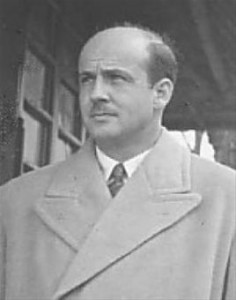
 Harold A. Sweet was a swashbuckling, Errol-Flynn-type pilot who became a real-life soldier of fortune. The Salt Lake City native was a self-taught pilot whose aviation exploits flying the ‘Orient’s flaming skies in the first black days’ of World War II made international headlines.
Sweet was born July 26, 1904 in Salt Lake City. He taught himself how to fly using a military surplus JN-4 ‘Jenny’ that he bought from the U.S. Army. He was an early barnstormer in the 1920s, performing aerial tricks and selling rides. He moved to the Philippines in 1930 and flew for the U.S. mail service for seven years.
In 1937 Sweet joined the Pan American-owned China National Aviation Corporation as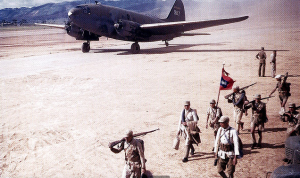 a captain. When war broke out in China, Sweet flew civilians out of beleaguered Hong Kong in unarmed transports. He later ferried civilians and top military personnel, along with supplies, to the Nationalist Chinese Army.
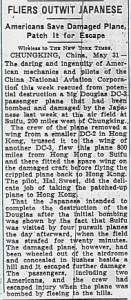 Sweet captured international headlines in 1941 for flying a DC-2 800 miles from Suifu, China to Hong Kong. The Chinese government determined that a partially damaged DC-3 stranded in Suifu was too priceless to fall into the hands of the Japanese. When a bomb splintered the wing of the plane after a Japanese air raid, Sweet made do. The only wing that was available was that of a DC-2, which was five feet shorter than the wing of the damaged DC-3. CNAC engineers came up with a plan to strap the wing to the belly of a DC-2 and fly it to Suifu. Sweet not only completed the journey with the spare wing, but also piloted the repaired ‘DC-2 1/2′ to Chung King.
He made headlines again when he flew a DC-3 with 3,000 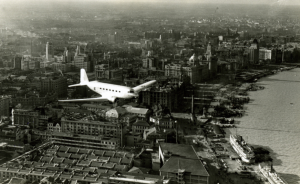 bullet holes in it. The plane was patched with a canvas awning but whistled so loudly it was dubbed ‘Whistling Willy.’ The plane’s engines also belched flames at one point. The Japanese in the area reportedly did not fly for three days when they heard the strange, fire breathing aircraft.
When China was overrun by the Japanese forces in 1941, Sweet and CNAC pilots 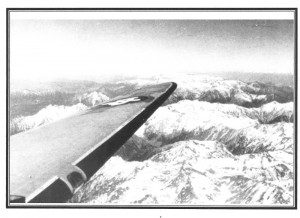 pioneered a dangerous supply route over the Himalayas to keep China in the war. Sweet flew over ‘The Hump‘ delivering supplies to the Flying Tigers. He left CNAC for a time in 1942-43 to ferry U.S. aircraft between Natal, Brazil and Legos, Nigeria to Cairo for Pan Am’s African counterpart, but returned to fly for the CNAC again.
After the war, Sweet started an airline of his own in the Philippines. When the business failed, he settled in San Marino, California with his wife and seven children and started an import-export business. He died of a massive heart attack on the golf course at age 43. Sweet was inducted into the Utah Aviation Hall of Fame in May 2012.