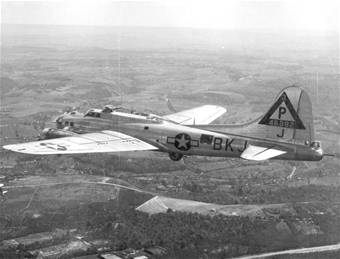
 The 384th Bombardment Group got its first taste of combat on June 22, 1943 with a bombing run on a motor plant in Antwerp, Belgium. Two B-17s were lost during the mission. As Ralph Lavoie, a ball turret gunner later recalled, it “certainly changed our minds about the seriousness of combat.”
Ralph Lavoie enlisted in the Army just after Labor Day in 1941. The Fitchburg, 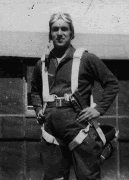 Massachusetts native found himself in the Army Air Force where he volunteered to be an aerial gunner. After completing gunnery school in Ft. Myers, Florida, Lavoie next went on to attend armorer’s school in Salt Lake City, Utah and then on to Boise, Idaho where he became part of a B-17 crew. The 384th Bombardment Group was comprised of the 544th, 545th, 546th and 547th Bombardment Squadron. The group left for Wendover Field in January 1943 where they were schooled in flying formations, gunnery and bombing. Lavoie described Wendover as “a God-forsaken place if ever there was one.” The 384th next moved on to Sioux City, Iowa in April for a few final weeks of training before shipping out for overseas duty with the Eighth Air Force.
The Group flew from Bangor, Maine to Newfoundland and then across the Atlantic to Grafton Underwood in England which was headquarters for the 384th Bob Group, 547th Bomb Squadron. The unit was tasked with strategic bombardment of air fields and industrial targets in France, Germany and surrounding Nazi-occupied areas. The 10 men aboard the B-17 “We E Hope” came from nine different states. As first armorer, Lavoie was responsible for the machine guns on the plane and also helped the ground crew load the bombs.
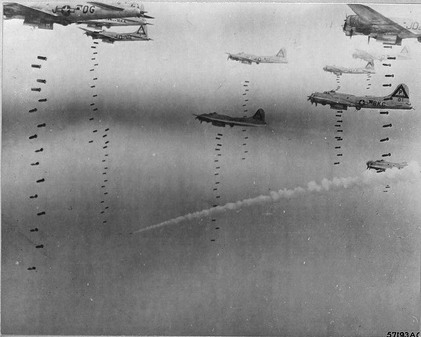 The 384th’s maiden run was a diversionary raid on a former General Motors automobile parts warehouse in Antwerp. Lavoie’s B-17 was on the right wing in the high squadron in the famous “combat box” formation. Two B-17s were lost to flak and Lavoie’s own bomber was also hit. A piece of flak shattered the sight on his ball turret making it impossible for him to see to aim. Lavoie, though, deceived enemy fighters by keeping the turret in motion to discourage fighters from attacking. “It was imperative that the ball turret keep moving and not let the Germans know it was disabled in any way,” Lavoie recalled. Otherwise the defenseless B-17 would have been a sitting duck for fighters.
The plane made it back safely but the damage to the turret put it out of commission for repairs. News accounts of the raid noted the new P-47 fighters that escorted the B-17s on the Antwerp raid shot down seven Nazi planes. Allied bombers also unloaded tons of bombs on Krefeld at night, a synthetic rubber plant at Huls, and shipyards at Rotterdam and Poix.