
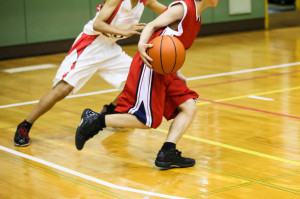
 As an offensive playmaker, improving your off-hand is vital. Whether you’re a guard or a center, your refined non-dominant hand will frustrate defenses endlessly.
Why is the off-hand so important?
Basketball is all about being unpredictable. And if a coach knows that you can only dribble with your right hand, they know you will only feel comfortable attacking the right side of the court. Oftentimes, your opposing defender will force you to dribble with your off-hand. If you’re ready for that kind of a defense, you’ll continue to carve up your opponent. With a strong off-hand, you’ve got double the options. But that sort of confidence and reliability takes hours at the gym.
First, make efforts to copy the action of your dominant hand. It may feel different, but if it looks the same, then you’re well on your way to developing good off-hand form. Dribble in front of a mirror to see how it should look. Muscle memory should help you bring that form to the court.
Before approaching your drills, you need to have a positive outlook. Remember that your off-hand is clumsy, but so was Chris Paul’s when he started these drills. He wouldn’t be in the NBA today if he hadn’t made his off-hand as strong as his dominant. So be patient with yourself — it will take time.
Get to practice early to run through a few off-hand warmup drills. Put your dominant hand behind your back. Start with low dribbles in front of your body (no higher than knee-height). After 30 seconds, move on to high dribbles in front of your body. Then, move the ball to the side of your body and do low and high dribbles for 30 seconds. Move onto the seesaw dribble, bringing the from the outside of your body to the middle.
As you get more advanced, you can practice sending the ball between your legs with your off-hand. And finally, you can move onto doing the routine with two balls. However, you will want to master the simpler drills before moving onto the more advanced drills.