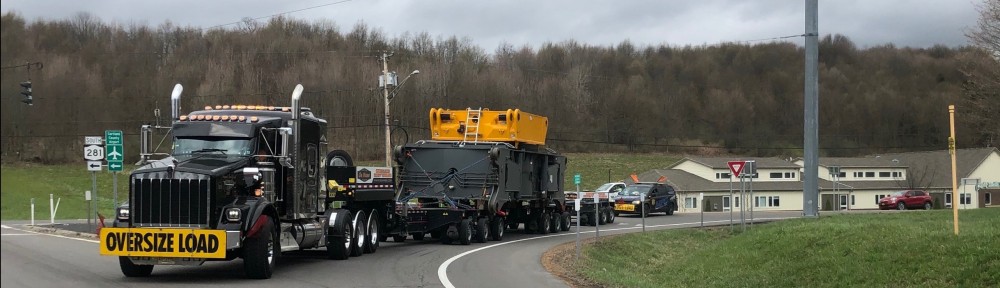
 Consider that nearly 70% of all freight shipped in the United States is hauled on a truck. The fact is this: Truckers haul our lives. But even though you see them everywhere, do you know what each trucker is hauling? You’ve probably wondered what, exactly, is in those shipping containers and where did they come from?
In this post, we’ll introduce you to the different types of equipment that you see rolling across your city’s streets and highways. That way, next time you’re on the open road, you too can identify the type of equipment traveling the road with you.
Flatbed trailers. A flatbed trailer has no sides or roof, making it ideal for transporting large, industrial products. At De Mase, we regularly use flatbed trailers to haul oversized loads and products with unusual shapes.
Step deck trailers. A step deck trailer, or lowboy, is specifically designed to carry products that exceed certain height limits. A step deck trailers’ design helps in these efforts because the floor drops down after it clears the tractor unit. In some cases, step deck trailers prevent the need for special permits.
Double drop trailers. Double drop trailers can carry weights of between 41,000 and 43,000 pounds without having to obtain special permits. Like step deck trailers, double drops accommodate tall objects and industrial equipment like bulldozers and backhoes.
9-axle trailers. 9-axle trailers are very specialized. They come in several different axle configurations, but all are designed to transport loads that are between 100,000 and 110,000 pounds. When completely loaded, a 9-axle trailer can exceed 100 feet, bumper to bumper. The majority of 9-axle trailers require special permitting for heavy or oversized loads.
13-axle trailers. 13-axle trailers are even larger than a 9-axle trailer. These freight-hauling juggernauts are designed to transport construction and mining equipment, as well as electrical turbines, manufacturing facilities, and more. Like 9-axle trailers, 13-axle trailers require special permitting.
At De Mase Trucking and Rigging, we’ve invested in a variety of specialized equipment to transport all size loads, especially superloads. A superload is any load that exceeds the dimensions of a state’s “routine permit limits” and is nondivisible. Nondivisible means the load can’t be separated into smaller, more manageable loads. Super loads often take weeks or even months to get state approval. They also require special documentation, including a shipper’s letter and route survey. We handle all that for you
These are the types of freight transportation we offer, but you’ll see many others out on the open road. If you need help preparing your next heavy load, you can count on us. We regularly move modules, transformers and reels as well as construction and mining equipment, statues, and more.
Even better? We have an in-house permitting department that can help you obtain the necessary paperwork. To learn more about our freight transportation capabilities, get in touch. Visit our website or call (201) 933 -7775 today. We look forward to collaborating with you.