
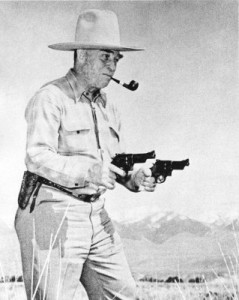
 The Ogden Arsenal was home to almost 6,000 workers during World War II – most of them women. But the most colorful character to have passed through its doors was a cigar chompin’, Stetson wearin’, six gun packin’ outspoken rancher named Elmer Keith.
Keith was born on March 8, 1899 in Hardin, Missouri at the end of the frontier period. Growing up around Civil War veterans and gunfighters, Elmer learned how to shoot from a former gunfighter turned barber by firing at the patterns in the linoleum in the back of the barber shop.
Keith was a rancher and big game guide in Oregon and Idaho during the 1920s and 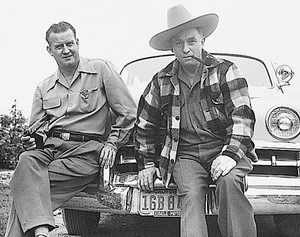 1930s. He was an avid handgun hunter and liked to hunt medium game with a double-action Smith and Wesson revolver.
Keith’s favorite handgun was the .32-20 Colt SA six gun but at a time when handgun cartridges fired large, slow bullets, he began experimenting with larger bullets with higher velocity. His experimentation led to the development of the .357 Magnum, .41 Magnum, and .44 Magnum.
Keith began writing gun related articles in the 1920s and he went on to become one of the most famous gun writers of all time. His first article was published in 1924 in the American Rifleman and he would go on to write ten books beginning with Sixgun Cartridges and Loads in 1936 and an autobiography, Hell, I was There.
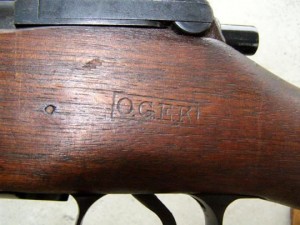 During World War II, Keith served as an inspector at the Ogden Arsenal. The arsenal manufactured and stored bombs, shells and ammunition and also rehabilitated combat-damaged artillery pieces and various caliber weapons. The rifles he inspected were stamped with the initials ‘OGEK’ in a rectangular box on the stock. Today these Springfield rifles are highly sought after collector’s items among gun enthusiasts.