In order for the strings of a stringed instrument to make sound, they must vibrate. Fingers are the most readily available tools to strike the strings, but over the ages astonishing assortments of apparatus have been applied to the strings.
In contrast to plucking the strings, the bow allows the musician to apply an unbroken stream of friction the instrument, thus maintaining the note. The violin, prized among stringed instruments because for its superb tone, was perfected in design by the Cremona masters. It was not until the bow reached its peak at the hands of Tourte, often called the “Stradivari of bows,” that stringed instruments achieved their full potential.
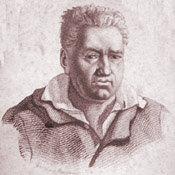
Francois Tourte was born in Paris in 1747. He was originally trained as a watchmaker, but turned his mechanical prowess instead to the music industry (his father was, after all, a bow maker).
Tourte applied complex physics to the shape of the stick. The stick of his bow was made of Pernambuco wood (Brazilian wood) which, though light, yields considerable power of resistance. It is a dense wood that will not float in water. Tourte used heat to bend the stick so that it was somewhat convex to the hair. Bows before Tourte curved away from the strings. This meant that the harder a musician pressed on a string, the more the bow curved. Tourte’s bow straightened as the player pushed harder on the strings, thus pulling the hair tighter and swiftly increasing the force administered to the string. The hair was painstakingly chosen from the very best horse hair; every one of the 150 or 200 hairs that made up the half-inch wide ribbon of each bow needed to be perfectly smooth and cylindrical.
The shape and flexibility of the bow was also enormously important: it communicated the musician’s slightest direction to the violin and allowed the sound to attain its aimed-for pitch without noise at the beginning of each new stroke.
It’s said that Beethoven specifically wrote the Kreutzer Sonata to be played by Rudolph Kreutzer using a Tourte bow; without such a bow, the sonata’s rapid passages could not have been played.