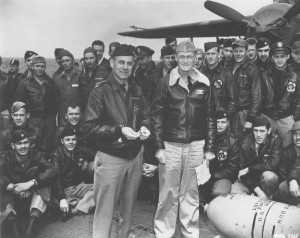
 On April 18, 1942, sixteen B-25 Mitchell medium bombers took off from the pitching deck of the aircraft carrier Hornet. Their mission was to bomb Tokyo and to show the Japanese people that they were not invulnerable to attack. Known as the Doolittle Raid, the mission was one of the most daring ever undertaken. Although the damage it inflicted was minimal, the raid proved to be a huge boost to morale in the early days of the war. It was also unique in that it was the only operation in which Army bombers were launched from an aircraft carrier into combat.
Following the attack on Pearl Harbor, President Franklin Roosevelt ordered the military to come up with a plan to strike back at Japan as soon as possible. Unfortunately, the Army Air Force had no bases closes enough to launch an attack, and the Navy had no planes with the required range to undertake an attack on the Japanese homeland without risking what remained of the fleet.
In January 1942, Captain Francis Low, the US Navy’s Assistant Chief of Staff for Anti-Submarine Warfare came up with a solution. While visiting Norfolk, Low observed US Army medium bombers taking off from a runway painted to resemble the outline of an aircraft carrier deck. Low thought that it would be possible for medium bombers to take off from a carrier at sea. The plan met the approval of Chief of Naval Operations Admiral Ernest King, who ordered a study to see whether the B-25 could take off from an aircraft carrier and have the range to reach the target. The twin engine B-25 was selected because it handled well, could take off at a short distance, and hold enough bombs and fuel to hit Japan and continue on to airfields in China.
General “Hap” Arnold of the U.S. Army Air Force also liked the idea, and selected the famed aviator Lieutenant Colonel James “Jimmy” Doolittle to command the mission. In February, two fully loaded B-25s successfully took off from the carrier Hornet, proving that the plane had what it took to accomplish the mission. Doolittle gathered a volunteer crew from the 17th Bomb Group for an unspecified and extremely hazardous mission. The B-25s were specially modified for the mission. Doolittle’s crew underwent extensive training at Eglin Field in Florida where they practiced taking off from a carrier, along with low-altitude flying and bombing..
The newly built USS Hornet was chosen to carry Doolittle’s B-25s toward Japan. The task force was supposed to ferry the planes to a launching point 400 miles from Japan, but was spotted by Japanese patrol boats on April 18 and forced to takeoff earlier than planned. The sixteen B-25s proceeded toward Japan and arrived over industrial targets in Tokyo, Yokohama, Kobe, Osaka, and Nagoya around noon. Each aircraft carried three high explosive bombs and one incendiary bomb.The planes encountered light anti-aircraft fire and successfully delivered their load against their targets, then headed southwest toward China. Running low on fuel because of their early departure and with the weather turning bad, the crews were forced to bail out over China or crash land. Fifteen of the bombers made it to China where they were aided by Chinese civilians. One successfully landed in Russia where the crew was interned.
The Doolittle Raid gave the country the morale boost it needed and embarrassed the Japanese high command. It forced the Japanese to redeploy units to defend the home island and provoked them into attempting a hasty strike at Midway which proved to be a disaster. Ironically, Doolittle thought the raid was a failure and expected to be court-martialed when he returned to the United States. Instead, he received a hero’s welcome and was awarded the Congressional Medal of Honor.