
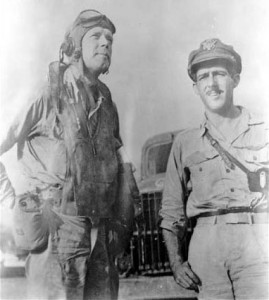
 Charles Lindbergh is probably best known for his non-stop solo flight across the Atlantic Ocean in May 1927. What you may not know though, is that the famous aviator also made a significant contribution in helping America win World War II as a test pilot.
Lindbergh became an instant international celebrity following his famous flight and an early promoter of aviation, but in the late 1930s lost much of his popularity with the American people for opposing America’s involvement in World War II. After war in Europe broke out in 1939, Lindbergh became associated with the America First movement, a group of prominent patriotic citizens who wanted American to remain neutral in the conflict. Lindbergh angered President Franklin Roosevelt and further alienated many Americans when he claimed that there were three groups pushing America into war: Great Britain, Roosevelt, and Jews.
When Pearl harbor was attacked by the Japanese on Dec. 7, 1941, Lindbergh and the America Firsters realized that remaining neutral was no longer possible. Lindbergh, who had resigned from the Air Corps as a result of his dispute with President Roosevelt, asked to be reinstated. Because he had earned the enmity of Roosevelt, officials in the administration made it clear that they did not want the former hero’s help. ”You can’t have an officer leading men who thinks we’re licked before we start,” Roosevelt said.
Anxious to still contribute, Lindbergh was hired by Henry Ford to help convert his facilities from auto production to work on the B-24. At the time, the government had asked Ford to build 1,200 B-24s. Production got underway in April 1941 at Ford’s Willow Run plant, the largest assembly plant in the world. The facility featured more than 2.5 million square feet of space. Lindbergh even called the Willow Run plant the “Grand Canyon of a mechanized world.” Working as a technical adviser, Lindbergh’s test flights helped trouble shoot some of the early problems with the new aircraft. As problems with the B-24 were ironed out, Lindbergh split his time between Ford and the United Aircraft Corp.
In January, 1944 Lindbergh convinced United Aircraft, who manufactured the F4U, to send him to the Pacific as a technical representative to observe US Marine Corps Corsair operations. On Guadalcanal, Lindbergh corrected problems with the “bent-winged bird.” Local Marine officials consented to allow Lindbergh to go on patrol, and on May 22, 1944, Lindbergh flew his first combat mission, escorting B-25s on a bombing run over Rabaul.
After leaving Guadalcanal, Lindbergh moved on to Hollandia where he was attached to the 475th Fighter Group evaluating the Lockheed P-38 Lightning. The unit’s CO was playing checkers at the time and brushed off the tall stranger’s request to familiarize himself with the P-38s combat operations asking “Are you a pilot?” not realizing that he was talking to the world’s most famous aviator.
Once in the air, the 42 year-old Lindbergh often bested men half his age with his ability and endurance. Drawing on his extraordinary flying experience, Lindbergh showed the other pilots how to conserve fuel and extend their combat range by 700 miles. “These are military engines, built to take punishment,” Lindbergh told his fellow pilots, “So punish them.” Soon, all pilots adopted Lindbergh’s approach of setting the RPMS lower and the manifold pressure higher so that the engine would consume less fuel.
When the war ended, Lindbergh had flown nearly 50 combat missions. Although Lindbergh never acknowledged that he was wrong about Hitler, after World War II the public forgave his pre-war activities and once again embraced the hero. He was even restored to the Air Force Reserves by President Dwight Eisenhower.
Later in life, Lindbergh worked as a consultant to Pan Am Airlines where he helped design the Boeing 747, won a Pulitzer Prize for his memoir, traveled the world, and became involved in conservation causes. He died in 1974.