
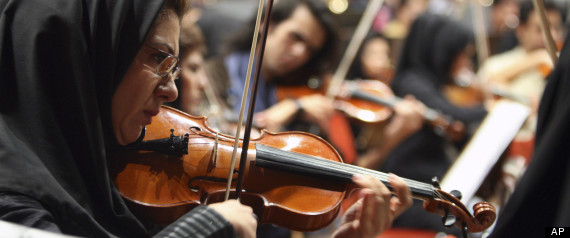
 Since 1933, the Tehran Symphony Orchestra has populated Iran’s sonic landscape. Enduring wars and revolution, the orchestra continued performing classics from around the world, broadening the horizons of Iranian attendees – until now.
Western cultural influences have been stifled and outright banned since the shah’s monarchy was toppled in 1979. Under the shah, Iran enjoyed visits from Western music-makers, including the Berlin Philharmonic, conducted by Herbert von Karajan who performed three times for Iranian audiences in November 1975. But with the secular-ruling shah overthrown, the radical new government under the Ayatollah began to dictate the most intimate and private activities of Iranian citizens, including what they wore, what books they could read, what music they could listen to, and much more. In the early 1980s, Iranian police routinely stopped citizens’ cars to check tape decks and ensure that no western/secular music was being played; offending tapes were smashed on the spot. Sharia law was to become the ultimate determiner of human behavior in Iran and the orchestra’s fate was uncertain.
But even when President Mahmoud Ahmadinejad banned Western music on state radio and television in 2005, somehow the orchestra managed to go on. The musicians never made good money, the most experienced among them pulling in 6m rials (the equivalent of $319) a month. As a result, most musicians had to supplement their income by taking second jobs or freelancing their skills to land additional performances.
Iran is ruled by the Shia school of Islam whose strictest clerics denounce music as an obstruction between God and faithful Muslim devotees. The line between religion and politics in Iran is nonexistent and the main incentive for disbanding the orchestra was clearly religio-political. Since the revolution in ’79, groups opposing the Ayatollah sought platforms to display their cause. The orchestra was used as such a platform, notably during its 2009 European tour when opposition supporters sported green accessories that symbolized the protest movement.
Musicians’ hopes soared in August when a man from the top of Iran’s theocracy, Supreme Leader Ayatollah Ali Khamenei, attended a VIP performance of the Tehran Symphony Orchestra in Dubai. However, mere months after the performance, the orchestra is unfunded, and the musicians are out of work. The motive, surely, is partially financial. With Western sanctions pinching Iran’s belt, the theocratic government had to cut back somehow and how better, in their view, than through the elimination of funding for a group that celebrates the rich musical production of those Western “infidels.”
In Tehran, the silence will be deafening.