
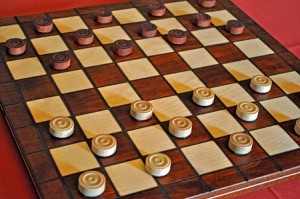
 Have you ever played a game of checkers with a young child? The games usually go a little something like this: Each turn that results in a lost piece prompts a total loss of concentration. They become addled, frustrated, and absorbed in the loss of a single piece rather than focused on moving forward strategically. In fact, often there are several winning moves open, but all they can see is what has been lost. While this is completely natural for a youngster who has been newly introduced to the game, it all too often mirrors the way we address our “adult” problems in life in a similar fashion.
When the plan we have so carefully crafted is disrupted by an unexpected misfortune (or even a minor frustration), it can be easy to focus most of our attention on the problem rather than zeroing in on positive actions that we can take to mitigate the negative impact of the unforeseen distraction. Simply put, when we focus on the problem, our momentum is lost. When we view setbacks as minor and inconsequential, our energy can be used to move us forward. Not to mention, we often realize opportunities that were made possible by what we perceived as a problem.
One strategy to riding the wave instead of being pummeled by it is to expect adversity to come. It is not a matter of IF, but WHEN. With that mindset, it isn’t a shock to be faced with a detour. As a seasoned checkers player, you expect to lose pieces. But it only takes one piece to win.
This article by Stephanie Treasure, a business consultant, has eight great tips on how to stay focused on the positive instead of losing our vision due to negative setbacks. Who knows, it may even make you a better opponent when playing checkers!
- Hope for the best, but plan for the worst You’ve heard this before, but do you apply this principle? Put all your efforts behind the best possible outcome for yourself and those involved, but have a game plan to handle unfavorable circumstances. Set aside time to play devil’s advocate with yourself, think of the things that may go wrong, and create possible solutions.
- Always look for the needle in the haystack There is a positive in every conflict or adverse circumstance; look for it and you may even find an opportunity. As Napoleon Hill said, “Every adversity, every failure, every heartache carries with it the seed of an equal or greater benefit. “ So seek, and ye shall find!
- Develop a filtering system Learn to filter out the negative chatter that tends to follow us where we go. If you are at the salon, bank or some other public place, tune out the negative. Keep a smile on your face always, and when asked, “How are you?” or some similar question, respond in a colorfully positive way. Respond with “Fabulous”, “Absolutely fantastic”, “Great!” When asked why you are in such a good mood, respond with a simple reply about something you’re grateful for in your life.
- Surround yourself with positive people Push back or guard yourself from negative people who second-guess your dreams. Align yourself with people who are working on or have achieved similar goals. When you associate with people who are driven and are pushing themselves to succeed, it helps you get your own momentum going. Positive people also make great cheerleaders!
- Set aside some time for physical fitness Establish a workout routine. This will help you feel better about yourself and it will pour over into your business, career and personal life. A balanced diet helps, too!
- Feed your mind Read motivational and inspirational material each day. You need to condition your mind day by day in order to stay positive. Make this a daily ritual, just like eating. Read stories or autobiographies of people who have overcome adversity. Know that the human spirit is strong, and if they can survive and thrive in tough times, you can too.
- Be grateful Start a gratitude journal and write down 3 to 5 things you are grateful for each day. Take a look at it if you start to feel down; it is guaranteed to cheer you up. Focus on what you have and be grateful for it. Being grateful for the little things prepares you to be grateful for the bigger things when they come your way.
- Volunteer Give your time or help financially if you can. Look outside of yourself for ways you can help in your local community or give to a global cause.